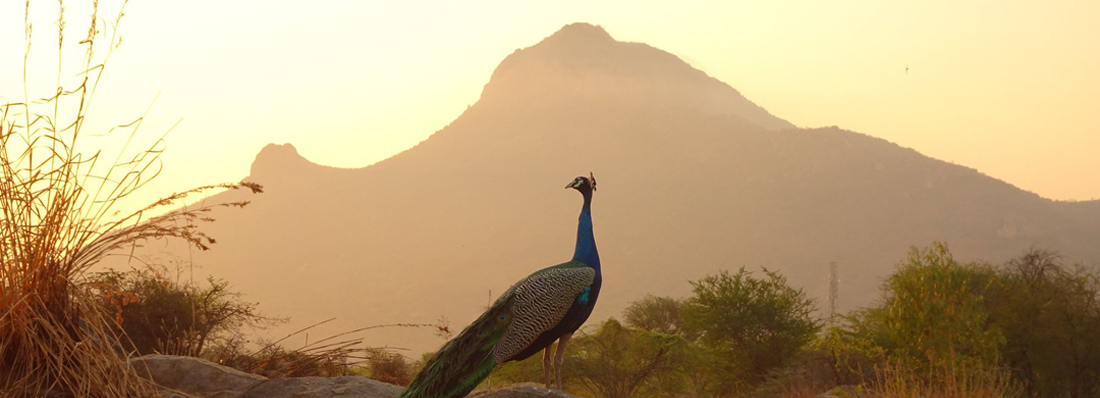
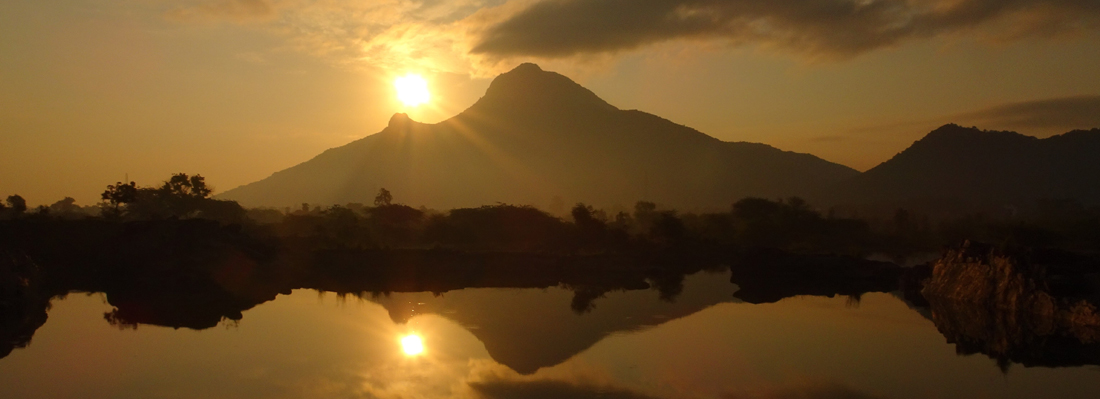
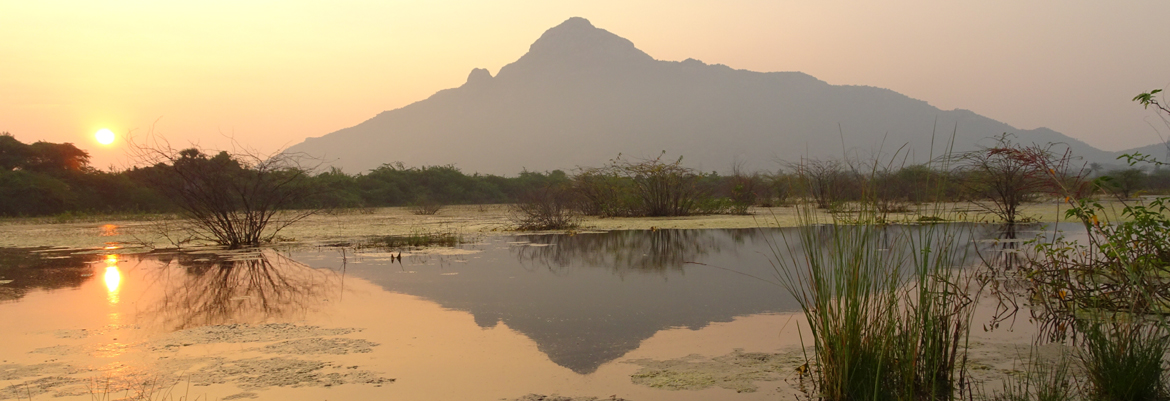
The mountain of Arunachala has been mostly bare for the last few decades. The forests that once clung to its slopes were felled and sold during Ramana Maharshi’s lifetime, and only small pockets of newly planted trees have replaced them. Attempts to reforest the mountain in the last few years have been sporadic, limited, and in many places unsuccessful. However, this year a confluence of circumstances has opened up new opportunities to restore the vegetation of Arunachala to its former glory.
At the beginning of August it began to rain, and it continued to rain for weeks and weeks. This was the first time in the memory of many people here that the summer rains had been so good. This made a perfect environment for planting new trees since saplings need to be established in wet ground for many months if they are to stand a chance of surviving the hot, rainless summer months (mid-March to mid June) in which temperatures rise to well over 40 degrees Celsius.
A friend of mine, Govind, felt inspired (both by the weather and by the birth of his first child) to begin planting trees at the foot of the mountain in the area adjacent to Kattu Siva Ashram, which is just off the inner pradakshina path, about a mile and a half from Sri Ramanasramam. Within a few weeks, and with the help of about twenty workers he recruited, he succeeded in planting several thousand trees. At this point he decided to do reforestation work on Arunachala as a full-time job. He approached our local chief forest officer and asked if there were any areas of the hill that he could take responsibility for. He was offered a piece of land adjacent to Palakottu, the area where many of Ramana Maharshi’s sadhu devotees lived in the 1930s and 40s.
The forest officer informed Govind that there was a new master plan for the reforestation of Arunachala, and that there were different plans for different parts of the hill. The area that Govind was offered appears on the master plan as a place where medicinal plants and trees were to be grown. The long-term goal was to turn it into a kind of botanical garden in which indigenous medicinal plants and trees could be displayed both to the general public and to local farmers, who would be encouraged to grow some of the medicinal products commercially.
Govind accepted responsibility for the land and in the last few months he has been working full-time to get the project off the ground. The land has been fenced, ponds have been excavated, irrigation channels have been dug, and over 3,000 trees have been planted. The rainy season is now over and for the next few months the emphasis will switch to keeping the trees alive until the next rains come, hopefully in 6-7 months time. During this period Govind wants to dig a large well on the land and start a nursery in which large numbers of medicinal plants will be grown.
All the work so far has been paid for by donations from devotees of Arunachala and Ramana Maharshi who have felt moved to support this work. All of us who have been involved in this work so far feel that this project is one that is well worth supporting. In addition to encouraging an awareness of the local medicinal flora, it will result in a major new forested area at the foot of Arunachala, in an area that is only a two-minute walk from Ramanasramam. If you would like to support this work, you can send donations
by clicking on the button below:
You may also send donations to the
following UK Account:
Account name: Mountain Of Medicine. Account number: 31876805. Sort code: 40-03-28
Address: HSBC, Holborn Circus Branch, 31 Holborn, London EC1N 2HR, UK
Cheques and money orders can also be sent in the name of Luke Bowley to Sri Ramanasramam, Tiruvannamalai, 606603, Tamil Nadu. In the case of money orders, please indicate on the M.O. that the money is for the Mountain of Medicine project.
The following description of the project, which is now known as ‘The Mountain of Medicine’, has been supplied by Govind himself.