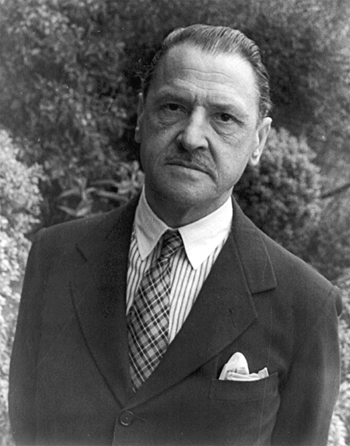
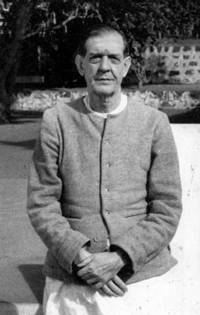
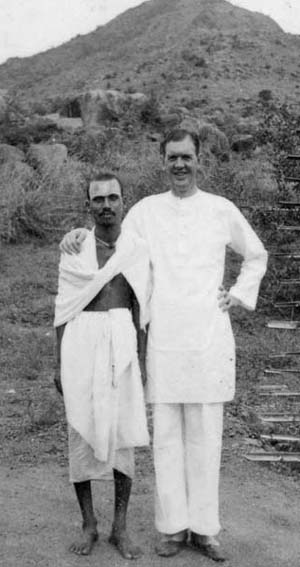
The principal characters in the 1946 film, The Razor’s Edge
This article was first published in The Mountain Path, 1988, pp. 239-45.
In January 1938 Somerset Maugham, the British novelist, visited Sri Ramanashram for a few hours. The brief contact he had with Bhagavan inspired Maugham so much, he decided to use him as the model for a fictional Guru in The Razor’s Edge, a novel of his that was published a few years later in 1944. Maugham also wrote a non-fiction account of his visit in an essay entitled ‘The Saint’, which was published twenty years after the event in 1958. The following account, which is taken from this essay, records Maugham’s impressions of this meeting with Bhagavan.
In the course of my journey to India I went to Madras and there met some people who seemed interested to know what I had been doing in India. I told them about the holy men who had suffered me to visit them, and they immediately proposed to take me to see a Swami who was the most celebrated and the most revered then in India. They called him the Maharshi.
Somerset Maugham
I did not hesitate to fall in with the suggestion and, a few days later, early one morning, we set out. After a dull hot drive along a dusty, bumpy road, dusty because the heavy wheels of ox-drawn wagons had left deep ruts in it, we reached the ashram. We were told that the Maharshi would see us in a little while. We had brought a basket of fruit to present to him, as I was informed that it was the graceful custom, and sat down to the picnic luncheon we had been sensible enough to put in the car. Suddenly, I fainted dead away. I was carried into a hut and laid on a pallet bed. I do not know how long I remained unconscious but presently I recovered. I felt, however, too ill to move. The Maharshi was told what had happened, and that I was not well enough to come into the hall in which he ordinarily sat, so, after some time, followed by two or three disciples, he came into the hut into which I had been taken.
What follows is what I wrote in my notebook on my return to Madras. The Maharshi was of average height for an Indian, of a dark honey colour with close-cropped white hair and a close-cropped white beard. He was plump rather than stout. Though he wore nothing but an exiguous loincloth he looked neat, very clean and almost dapper. He had a slight limp, and he walked slowly, leant on a stick. His mouth was somewhat large, with thickish lips and the whites of his eyes were bloodshot. He bore himself with naturalness and at the same time with dignity. His mien was cheerful smiling, polite; he did not give the impression of a scholar, but rather of a sweet-natured old peasant. He uttered a few words of cordial greeting and sat on the ground not far from the pallet on which I lay.
After the first few minutes during which his eyes with a gentle benignity rested on my face, he ceased to look at me, but, with a sidelong stare of peculiar fixity, gazed, as it were, over my shoulder. His body was absolutely still, but now and then one of his feet tapped lightly on the earthen floor. He remained thus, motionless, for perhaps a quarter of an hour; and they told me later that he was concentrating in meditation upon me. Then he came to, if I may so put it, and again looked at me. He asked me if I wished to say anything to him, or ask any question. I was feeling weak and ill and said so; whereupon he smiled and said, ‘Silence is also conversation’. He turned his head away slightly and resumed his concentrated meditation, again looking, as it were, over my shoulder. No one said a word; the other persons in the hut, standing by the door, kept their eyes riveted upon him. After another quarter of an hour, he got up bowed, smiled farewell, and slowly, leaning on his stick, followed by his disciples, he limped out of the hut.
I do not know whether it was the consequence of the rest or of the Swami’s meditation, but I certainly felt much better and in a little while I was well enough to go into the hall where he sat by day and slept at night. It was a long, bare room, fifty feet long, it seemed to me, and about half as broad. There were windows all around it, but the overhanging roof dimmed the light. The Swami sat on a low dais, on which was a tiger skin, and in front of him was a small brazier in which incense burnt. Now and again a disciple stepped forward and lit another stick. The scent was agreeable to the nostrils. The faithful, inhabitants of the ashram or habitual visitors, sat cross-legged on the floor. Some read, others meditated. Presently, two strangers, Hindus, came in with a basket of fruit, prostrated themselves and presented their offerings. The Swami accepted it with a slight inclination of the head and motioned to a disciple to take it away. He spoke to the strangers and then, with another inclination of the head, signified to them that they were to withdraw. They prostrated themselves once more and went to sit among the other devotees. The Swami entered that blissful state of meditation on the infinite which is called Samadhi. A little shiver seemed to pass through those present. The silence was intense and impressive. You felt that something strange was taking place that made you inclined to hold your breath. After a while I tiptoed out of the hall.
Later I heard that my fainting had given rise to fantastic rumours. The news of it was carried throughout India. It was ascribed to the awe that overcame me at the prospect of going into the presence of the holy man. Some said that his influence, acting upon me before I even saw him, had caused me to be rapt for a while in the infinite. When Hindus asked about it, I was content to smile and shrug my shoulders. In point of fact that was neither the first nor the last time that I have fainted. Doctors tell me that it is owing to an irritability of the solar plexus which pressed my diaphragm against my heart.
…Since then, however, Indians come to see me now and then as the man who by the special grace of the Maharshi was rapt in the infinite, as his neighbours went to see Herman Melville as the man who had lived among cannibals. I explain to them that this bad habit of mine is merely a physical idiosyncrasy of no consequence, except that it is a nuisance to other people; but they shake their head incredulously. How do I know, they ask me, that I was not rapt in the infinite? To that I do not know the answer, and the only thing I can say, but refrain from saying for fear it will offend them, is that if it was, the infinite is an absolute blank. The idea of theirs is not so bizarre as at first glance it seems when one remembers their belief that in deep, dreamless sleep consciousness remains and the soul is then united with the infinite reality which is Brahman…
The interest aroused by this incident, unimportant to me, but significant to Maharshi’s devotees, has caused them to send me a mass of material concerned with him, lives, accounts of his daily activities, conversation with him, answers to the questions put to him, expositions of his teachings and what not. I have read a great deal of it. From it I have formed a vivid impression of the extraordinary man he was..(The Saint, pp. 2-5, published by Heinemann, 1958)
Major Chadwick has written about this visit on pages 37-40 of his memoir A Sadhu’s Reminiscences. His account of Maugham’s brief darshan is substantially the same. However, he criticised Maugham for inventing a trip to the old hall that never took place:
Major Chadwick
After [giving darshan to Maugham in my room] Bhagavan returned to the hall [while] the rest of the party remained in my room for tea. After tea, Somerset Maugham, who was wearing a large pair of boots, wanted to go to the hall and see where Bhagavan usually lived. I took him to the western window through which he looked for some time with interest, making mental notes. He says in his indifferent and quite uninspired article The Saint, published in a series of essays twenty years after the event, that he sat in the hall in Bhagavan’s presence, but this is untrue, because he could not enter with his boots; he only gazed into the hall from outside. He has also tacked a certain amount of philosophy onto Bhagavan which Bhagavan would never have uttered in his life. But such is the habit of famous authors, to put their own opinions in the mouths of others.
In his recent articles Somerset Maugham says that because of his fainting fit, which some Indians regarded as a high state of samadhi, which he denies, he has been sent a mass of literature concerning Maharshi. This may be true, but it is certainly true that he wrote to the ashram and told them that he was going to write about Bhagavan and asked for as much material as they could send. He pointed out at the time that, of course, if he wrote anything it would be a wonderful advertisement for the ashram and the Maharshi. As if it were needed!
There is one other brief account of Maugham’s visit in Talks with Sri Ramana Maharshi, talk no. 550. That version concludes by saying: ‘The author [Maugham] attempted to ask questions but did not speak. Major Chadwick encouraged him to ask. Sri Bhagavan said, ‘All finished. Heart talk is all talk. All talk must end in silence only.’
Annamalai Swami and Major Chadwick
This account was written by Annamalai Swami on the day that the darshan took place. When I spoke to Annamalai Swami recently [1988] about this meeting he told me that he, Bhagavan, Chadwick and Maugham were sitting in silence for about half an hour in the room. He also told me that Bhagavan’s remarks were uttered in English, rather than Tamil, because there was no interpreter there at the time.
Maugham left India about two months later and returned to his home in the South of France. In 1940, after Germany invaded and conquered France, he went to America and lived there for the remainder of the war. He settled in South Carolina where he completed the writing of The Razor’s Edge, the novel in which the fictional Bhagavan appeared.
The hero of the book, Larry Darrel, is a young American drifter who wanders around the world in an attempt to find peace of mind and answers to some of the fundamental questions that have traditionally perplexed spiritual seekers. He comes to India and finds what he is looking for in a South Indian ashram that is presided over by a Guru who is clearly Bhagavan masquerading under a different name. After staying several years at the ashram, a contented Larry Darrel returns to America at the end of the book with the aim of living, so far as it is possible in the West, the life of a sadhu.
There has been considerable speculation among Maugham scholars as to whether the life and character of Darrel is derived from a real-life devotee of Bhagavan. The question appeared to be settled a few months ago when Wilmon Menard, an American author who has written a play based on Maugham’s life, wrote an article that was published in the May-June [1988] issue of Namaskar, the in-flight magazine of Air India. Menard stated in the article that he had spoken at length to Maugham about the writing of The Razor’s Edge. In an interview that he gave in the South of France, Maugham apparently told him that he had met an American devotee called Guy Hague at Sri Ramanasramam and had immediately decided to use him as a model for the main character in his next book. A friend of mine sent a copy of this article to a Mr Dennis Wills, an American researcher who had previously written to Sri Ramanashram asking for information about Hague’s stay there and Maugham’s brief visit to Bhagavan. I also wrote to Mr Wills since I had collected a few facts about Maugham and Hague that I thought would be of interest to him.